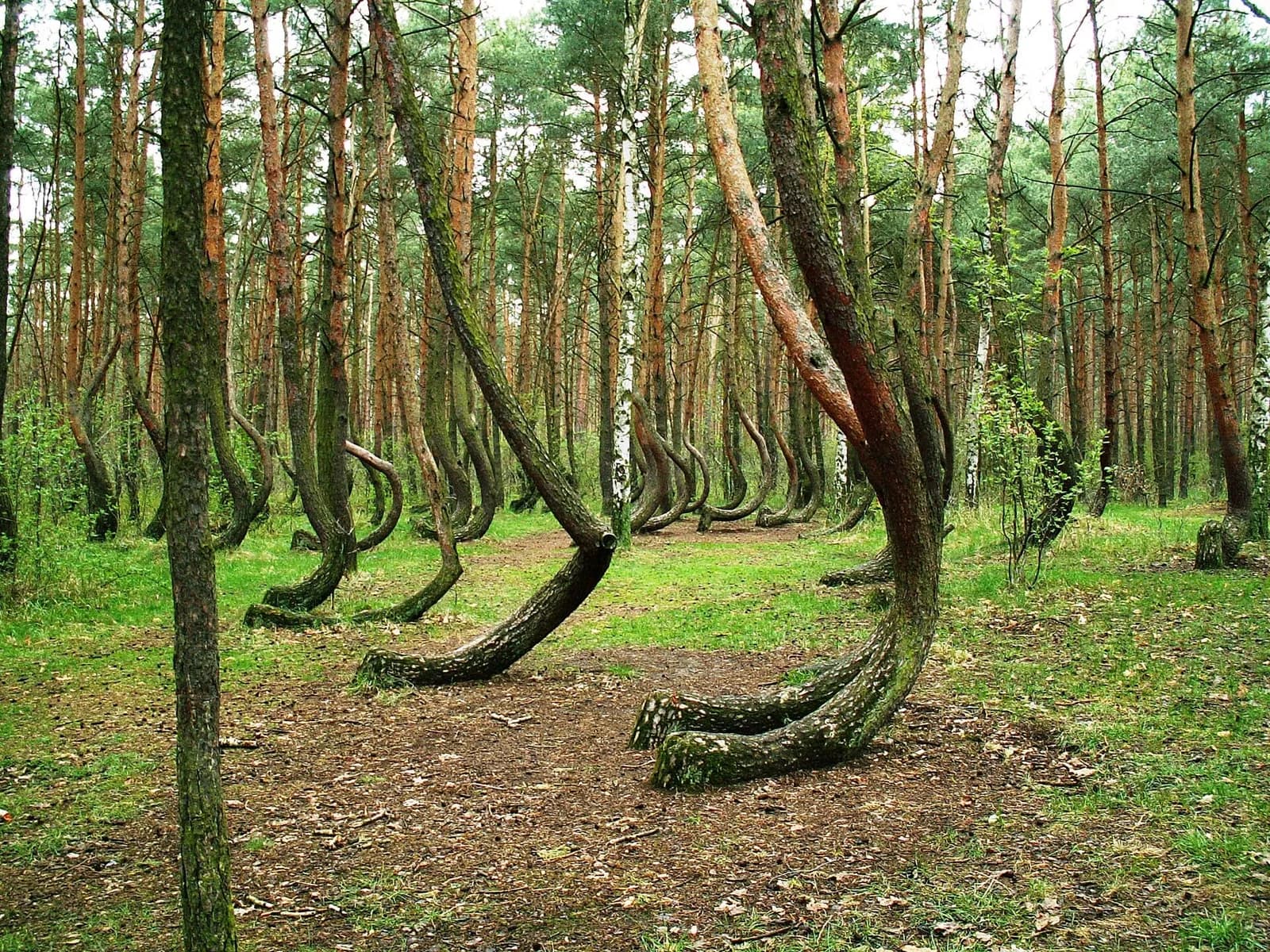
Just south of Szczecin lies one of Poland's most unusual natural landmarks. Hidden near the village of Nowe Czarnowo, the Crooked Forest, known in Polish as Krzywy Las, is home to a grove of pine trees unlike any other. Their trunks bend dramatically close to the ground before turning skywards, creating a landscape that appears almost surreal.
For decades, the forest has attracted photographers, nature enthusiasts and curious travellers from around the world. Despite extensive interest, no one has been able to prove exactly why these trees grew this way, leaving the Crooked Forest as one of West Pomerania's most enduring mysteries.
A Forest Unlike Any Other
The Crooked Forest is located around four kilometres south of Gryfino and approximately 25 kilometres from Szczecin. The grove contains just over one hundred protected Scots pine trees, although older descriptions of the wider plantation often refer to around 400 curved specimens.
Each tree follows an almost identical pattern. The trunk begins growing normally before bending sharply just above ground level. It then extends horizontally for several metres before curving upwards and continuing its growth as a straight pine.
What makes the grove particularly remarkable is the consistency. Nearly every tree bends in the same direction, while neighbouring pines outside the grove grow perfectly straight.
Theories Behind the Curves
No written records have survived to explain the unusual shapes, but several theories have emerged over the years.
The explanation considered most likely by foresters is that the young trees were deliberately shaped by people. It is believed that when the saplings were between seven and ten years old, they may have been bent using stakes, frames or weights to produce naturally curved timber.
At the time, curved wood was valuable for practical uses, including boat building, furniture making, wagon construction and sled runners. If this was indeed the intention, the work appears to have been abandoned, most likely as the Second World War disrupted forestry operations in the region.
Other suggestions have included heavy snowfall, military vehicles flattening young trees or unusual natural forces. While these ideas continue to fuel local folklore, none have been supported by convincing scientific evidence.
A Landscape Shaped by History
When the pines were planted in the early 1930s, the area formed part of Germany. Following the Second World War, the borders shifted and the region became part of Poland.
Any forestry records that may have documented how or why the trees were shaped are believed to have been lost during this period of upheaval. That absence of documentation has allowed the mystery to endure for generations.
A Favourite Destination for Visitors
Although relatively small, the Crooked Forest has become one of the most photographed natural attractions in West Pomerania. Visitors often combine a trip to the grove with exploring Gryfino, the Lower Oder Valley or a day out from Szczecin.
The site is especially popular with photographers, particularly during sunrise and autumn when soft light and colourful foliage enhance the unusual forms of the trees. The peaceful woodland setting also makes it an enjoyable stop for walkers and cyclists exploring the surrounding countryside.
Protected for Future Generations
Today, the Crooked Forest is protected as a natural monument and managed by the Gryfino Forest District. As the trees approach a century in age, preserving this remarkable grove has become increasingly important.
Whether their shape resulted from skilled forestry techniques or an explanation that has simply been lost to history, the Crooked Forest remains one of Poland's most fascinating landscapes. It is a reminder that some of the country's most memorable places are not grand monuments or castles, but quiet corners of woodland where nature and history continue to raise unanswered questions.
image credit: 7alaskan, CC BY-SA 3.0