Few buildings in Szczecin reveal the city's changing fortunes as clearly as the castle, rebuilt repeatedly as rulers, borders and ideas changed.
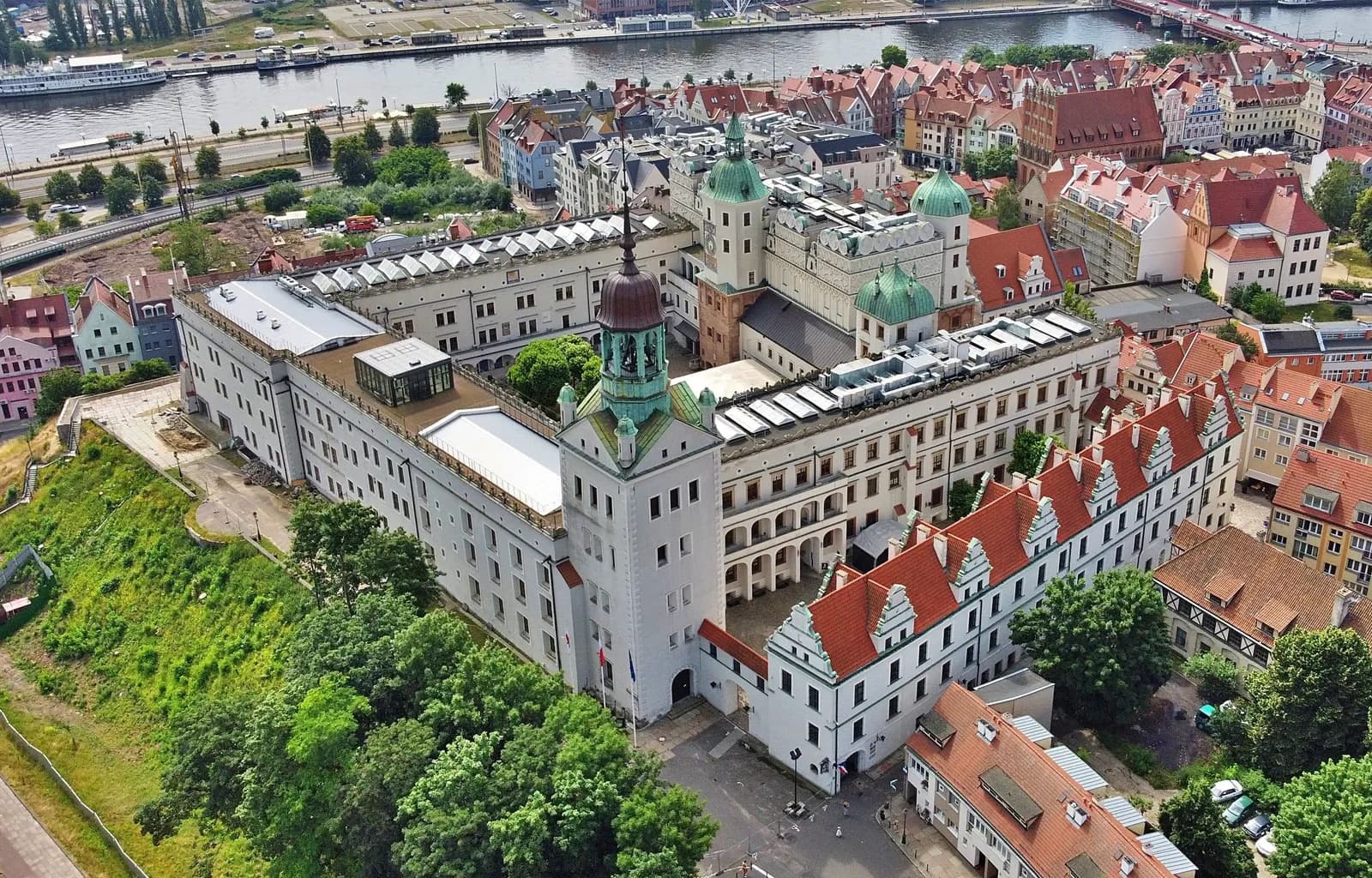
Rising above Szczecin's Old Town, the Pomeranian Dukes' Castle is more than the former residence of a vanished dynasty. Its five wings and courtyards embody centuries of political change, architectural ambition, destruction and reconstruction.
For more than 500 years, the Griffin dynasty ruled Pomerania, a territory stretching along the southern Baltic and eventually divided between what are now Poland and Germany. The castle became the most important seat of those rulers, but its story began long before the Renaissance complex visible today.
From Slavic stronghold to Griffin residence
The castle stands on a natural elevation beside the Oder, where the river flows towards Lake Dąbie. Archaeological evidence shows that the hill was occupied as a Slavic stronghold before the Christianisation of Pomerania in the 12th century.
Wartislaw I, regarded as the founder of the Griffin dynasty, is associated with an early wooden ducal residence on the hill. After Duke Barnim I transferred the capital of the duchy to Szczecin in 1235, the settlement and its ducal residence grew in importance.
The oldest surviving evidence of the medieval castle dates from the mid-14th century, when Duke Barnim III developed the northern part of the hill. A stone residence known as the Stone House was built alongside a castle church dedicated to St Otto, the missionary associated with the Christianisation of Pomerania.
The ducal residence subsequently expanded southwards. What began as a fortified medieval seat gradually became a complex combining political authority, religious life and representation.
The transformation accelerated under Bogislaw X, who reunited the previously divided Duchy of Pomerania and made Szczecin its capital. Work on the so-called Big House continued, with its great vaulted hall becoming associated with one of the most celebrated events in the castle's history: Bogislaw X's marriage to Anna Jagiellon, daughter of King Casimir IV of Poland, in 1491.
The marriage strengthened the Griffin dynasty's connections with the Polish royal house. Anna gave birth to eight children, helping secure the continuation of the dynasty that would rule Pomerania for another century and a half.
The Renaissance residence of the Griffins
During the 16th century, the castle changed from a medieval stronghold into a sophisticated Renaissance residence.
Barnim XI added a third floor to the Big House and introduced the staircase tower now known as the Clock Tower. The architecture combined late-Gothic forms with Renaissance decoration, while the interiors featured painted walls, elaborate vaults and scenes inspired by the Bible and Ovid's Metamorphoses.
A fire in 1551 led to further reconstruction, including the eastern wing, completed in 1559.
The most extensive transformation came under Duke John Frederick in the 1570s and 1580s. Earlier buildings were demolished and replaced, including the medieval St Otto's church and Stone House. New northern and western wings completed the four-sided courtyard, while Italian craftsmen helped give the complex its distinctive Renaissance appearance.
The castle was also becoming a centre of collecting and scholarship. In the early 17th century, Duke Philip II began construction of the western Mint Wing to house his library and substantial collections of paintings, sculptures, coins, precious objects and curiosities.
The Renaissance castle reached its fullest form shortly before the Griffin dynasty disappeared.
Bogislaw XIV, the last Griffin ruler, died childless in 1637. After the Thirty Years' War, the Duchy of Pomerania was divided between Sweden and Brandenburg. The castle ceased to be the seat of an independent Pomeranian dynasty and entered another chapter of its history.
From royal residence to ruin and reconstruction
Under Swedish rule, the castle remained an important residence, despite damage sustained during the siege of Szczecin in 1677. A particularly memorable addition dates from 1693, when the astronomic clock by Kaspar Nitardy was installed on the Clock Tower. It remains one of the castle's distinctive features.
In 1720, Szczecin passed to Prussia. The former ducal residence gradually lost much of its Renaissance character as its buildings were adapted for administrative and military purposes.
The castle became associated with several figures from European royal history during this period. Catherine Leszczyńska, wife of the Polish king Stanisław Leszczyński, lived there with her daughters during the Northern War, while Princess Elisabeth Christine Ulrike of Brunswick-Wolfenbüttel spent decades in exile at the castle before her death in Szczecin in 1840.
By then, successive alterations had changed the appearance of the former Griffin residence. Nineteenth-century Romantic tastes led to further modifications, including a neo-Gothic tower and the removal of Renaissance features.
The greatest rupture came during the Second World War. Allied bombing on 17 August 1944 destroyed the roofs, interior walls and much of the historic furnishing. Around 60 per cent of the building's substance was assessed as damaged.
Yet the castle was not abandoned.
After Szczecin became part of Poland in 1945, the ruined residence was regarded as one of the city's most important historic monuments. Archaeological work uncovered the ducal burial crypt and sarcophagi, while reconstruction plans sought to recover the Renaissance appearance of the castle.
The rebuilding took place in two principal stages between 1958 and 1985. The Renaissance form was reconstructed using historical evidence, including a detailed 1652 engraving by Matthäus Merian. The northern and eastern wings were rebuilt first, followed by the remaining three wings.
When reconstruction was completed in 1985, the castle had effectively gained another historical layer: a 20th-century reconstruction of a Renaissance residence whose surviving fabric had endured medieval development, royal occupation, administrative conversion and wartime destruction.
A castle that remains part of Szczecin's life
Today, the Pomeranian Dukes' Castle is not simply a monument to the Griffins. It is a working cultural institution, with permanent and temporary exhibitions, performances and public events.
The northern wing contains exhibitions exploring the history of the castle, the former ducal court and the Griffin dynasty. Visitors can also see the ducal crypt and historic objects associated with the residence. The Bell Tower and Ducal Terrace offer views across Szczecin and the Oder.
The castle's current exhibitions also make its architectural history visible. Beneath glass floors, archaeological remains of the medieval Stone House, early church and defensive walls can be seen within the reconstructed building.
This layering is perhaps the most compelling way to understand the castle. Medieval foundations sit beneath Renaissance forms; royal residences became offices; a wartime ruin became a reconstruction; and a former seat of rulers became a public cultural space.
The castle has therefore never belonged to just one period. Its timeline is the story of Szczecin itself, shaped by changing rulers, borders and political identities. What survives today is not simply an old ducal residence, but a building in which those successive chapters remain visible, sometimes beneath the floor, sometimes in the walls and sometimes in the activities taking place there today.
Visitor Information
Pomeranian Dukes' Castle in Szczecin
ul. Korsarzy 34, Szczecin.